
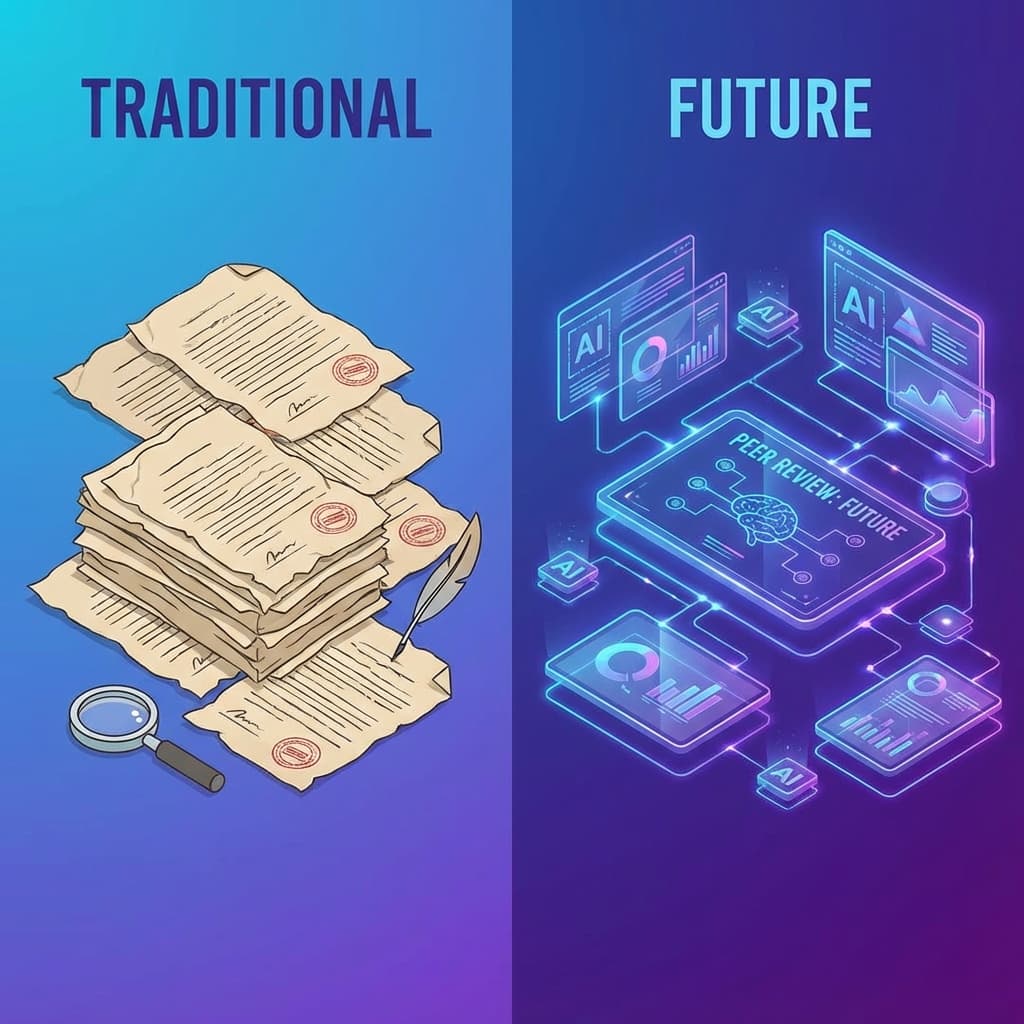
The Future of Peer Review: Can AI Fix a Broken System?
Peer review is the backbone of scientific integrity, but it's under strain. Can AI tools help alleviate the burden and improve quality?
PaperSight Team
PaperSight AI
The peer review system stands as the cornerstone of scientific credibility. It's how we separate rigorous research from unsupported claims, how we maintain standards in academic publishing, and how we build trust in scientific knowledge. But this centuries-old system is showing signs of strain—and many are looking to Artificial Intelligence as a potential solution.
In this analysis, we examine the challenges facing peer review today, explore how AI might help, and consider the ethical implications of automated involvement in scientific evaluation.
The Current State of Peer Review
To understand whether AI can fix peer review, we first need to understand what's broken.
A System Under Pressure
The modern peer review system evolved when scientific publishing was a fraction of its current scale. Today, that system is stretched to its limits:
By the Numbers
- Over 3 million papers are published annually worldwide
- The average paper receives 2-3 reviews
- Reviewers are rarely compensated for their time
- Review turnaround times have stretched to months, sometimes years
Key Challenges
Reviewer Shortage
Finding qualified reviewers has become increasingly difficult. Senior researchers are overwhelmed with requests, while early-career researchers often lack the recognition to be invited.
Increasing Turnaround Times
What once took weeks now takes months. Lengthy review processes delay the dissemination of important research and create frustration for authors.
Inconsistent Quality
Some reviews are thorough and constructive; others are superficial or biased. The variability in review quality undermines the system's reliability.
Bias and Conflicts of Interest
Studies have documented various forms of bias in peer review:
- Gender bias (papers by women receive different treatment)
- Institutional prestige bias (papers from famous institutions are evaluated differently)
- Geographic bias (papers from certain regions face higher scrutiny)
- Positive result bias (papers with negative findings are harder to publish)
Fraud and Error Detection Failures
High-profile retractions continue to occur despite peer review. The system often fails to catch:
- Statistical errors and p-hacking
- Image manipulation and duplicate figures
- Plagiarism and data fabrication
- Conflicts of interest in funded research
Reproducibility Crisis
Many published findings fail to replicate in subsequent studies. If peer review worked perfectly, wouldn't it catch unreproducible research before publication?
"The peer review system is like democracy—the worst system except for all the others that have been tried." — Anonymous journal editor
Where AI Can Help
Artificial Intelligence isn't a silver bullet, but it can address specific pain points in the peer review process.
Technical Verification
AI excels at tasks that require systematic checking across large bodies of text:
Statistical Consistency
AI can automatically verify that reported statistics are internally consistent. Tools like Statcheck already catch common statistical reporting errors that human reviewers miss.
For example:
- Does the reported p-value match the provided test statistics?
- Are confidence intervals correctly calculated?
- Is the sample size consistent throughout the paper?
Already in Practice
Several journals now automatically run statistical checking software on submitted manuscripts before they reach human reviewers.
Reference Verification
AI can check whether citations actually support the claims being made. It can:
- Verify that cited papers exist and are correctly attributed
- Check the context of citations for misrepresentation
- Identify missing citations to relevant work
- Flag potential citation padding
Plagiarism and Duplication Detection
AI-powered plagiarism detection has become sophisticated:
- Text overlap detection across millions of published papers
- Paraphrase detection that catches more subtle plagiarism
- Self-plagiarism identification for excessive text reuse
- Translation plagiarism detection across languages
Image and Figure Analysis
Some of the most damaging research fraud involves manipulated images. AI is becoming adept at detecting:
- Copy-paste duplication within and across figures
- Splicing where images are composited from different sources
- Enhancement manipulation that alters the apparent results
- Deletion or addition of elements within images
These analyses can flag suspicious images for human examination, catching issues that human reviewers rarely notice.
Manuscript Screening
Before manuscripts even reach reviewers, AI can assist with initial screening:
Formatting Compliance
- Does the manuscript meet word limits?
- Are figures in the correct format?
- Are all required sections present?
- Does the reference format match journal requirements?
Scope Assessment
- Does the topic match the journal's focus?
- Is the manuscript a reasonable fit for this outlet?
- Are there better-suited journals for this work?
Novelty Assessment
- Has this exact study been published before?
- How does this work relate to existing literature?
- What appears to be the unique contribution?
Reviewer Matching
Finding appropriate reviewers is a time-intensive task for editors. AI can:
- Analyze manuscript content to identify relevant expertise
- Search for researchers with matching publication histories
- Check for potential conflicts of interest
- Consider previous reviewer availability and response rates
- Balance reviewer workload across the community
Privacy Consideration
Reviewer matching systems must balance effectiveness with privacy, ensuring they don't expose sensitive information about researchers or their relationships.
Quality Prediction
Some AI systems aim to predict manuscript quality or eventual impact:
- Likelihood of acceptance at different journals
- Prediction of citation counts
- Assessment of methodology rigor
- Estimation of reproducibility likelihood
However, these predictions should be used cautiously and never as sole determinants of publication decisions.
Where AI Should Not Replace Humans
Despite AI's capabilities, certain aspects of peer review must remain firmly in human hands.
Evaluating Novelty and Significance
Is this research truly novel? Does it make a significant contribution to the field? These are fundamentally human judgments that require deep understanding of the field's history, current state, and future directions.
AI can identify what's been done before, but it cannot tell us what matters.
Assessing Conceptual Validity
Is the research question important? Is the theoretical framework sound? Does the logic of the argument hold? These require human expertise, creativity, and judgment.
Contextual Understanding
Much of research quality is contextual:
- A methodology that's appropriate in one field may be inappropriate in another
- The significance of a result depends on the state of the field
- The value of negative results depends on the questions being asked
AI lacks the contextual understanding that experienced human reviewers bring.
Mentorship and Development
Peer review isn't just gatekeeping—it's also mentorship. Good reviews help authors improve their work. They teach early-career researchers about standards in their field. This developmental function requires human empathy and pedagogical skill.
Critical Concern
If AI handles all the "routine" reviewing, early-career researchers will lose valuable opportunities to develop reviewing skills themselves.
Ethical Judgment
Some research requires ethical evaluation:
- Does the research treat human subjects appropriately?
- Are there potential harmful applications?
- Are there issues of representation or marginalization?
These are inherently human concerns requiring human judgment.
Ethical Considerations
Introducing AI into peer review raises important ethical questions that the scientific community must address.
Transparency and Disclosure
Should authors know if AI was used in their review?
There's an argument for transparency—authors should know what tools evaluated their work. But there's also an argument that reviewers' toolchains should remain private.
Should reviewers disclose AI use in their reviews?
If a reviewer uses AI to check statistics or identify related work, should this be disclosed? The field hasn't yet reached consensus.
Algorithmic Bias
AI systems can perpetuate or amplify existing biases:
- If trained on historically biased decisions, AI may replicate those biases
- Language models may favor certain writing styles or phrasings
- Novelty detection might disadvantage research from underrepresented traditions
Rigorous testing for bias is essential before deploying AI in peer review.
Accountability
Who is responsible when AI makes a mistake?
If an AI tool misses a statistical error that leads to a retraction, who bears responsibility? The tool developers? The journal? The reviewers who trusted the tool?
Data Privacy
AI systems require training data, often including submitted manuscripts. This raises questions:
- How is the confidentiality of unpublished work protected?
- Can AI companies use manuscripts to train commercial products?
- What happens if AI systems leak or expose confidential submissions?
Power Dynamics
The institutions that control AI tools gain significant power over science:
- Who develops and maintains these tools?
- Who decides what counts as "quality" in the algorithm?
- How do we prevent corporate or political influence?
A Balanced Vision for AI-Augmented Peer Review
Based on this analysis, we propose a balanced approach to integrating AI into peer review.
AI Should Handle
- Technical verification: Statistics, references, formatting, image integrity
- Administrative tasks: Reviewer matching, scope screening, compliance checking
- Assistance tools: Helping reviewers find relevant literature, highlighting potential issues
Humans Must Retain
- Final decisions: All publication decisions remain with human editors and reviewers
- Substantive evaluation: Novelty, significance, theoretical soundness, ethical concerns
- Mentorship function: Constructive feedback that develops authors
Transparency Principles
- Clear disclosure of AI tool usage
- Algorithmic auditing for bias
- Preservation of manuscript confidentiality
- Human oversight of all AI recommendations
Governance Requirements
- Community involvement in tool development
- Open discussion of standards and thresholds
- Regular assessment and adjustment
- International and interdisciplinary representation
Looking Ahead
The integration of AI into peer review is not a question of if, but how. Handled thoughtfully, AI can:
- Reduce burden on overworked reviewers
- Catch errors that humans miss
- Speed up the review process
- Reduce certain forms of bias
- Free humans to focus on substantive evaluation
Handled poorly, AI could:
- Introduce new biases
- Reduce the developmental value of reviewing
- Concentrate power in the hands of tool developers
- Undermine trust in the scientific process
The Path Forward
The scientific community must engage actively in shaping how AI is integrated into peer review. This is too important to leave to technologists alone or to market forces.
Conclusion
Peer review is indeed under strain, but it's not broken beyond repair. AI offers genuine potential to help—not by replacing human judgment, but by augmenting human capabilities and handling the aspects of review where machines genuinely excel.
The future of peer review is neither fully human nor fully automated. It's a partnership in which AI handles the systematic and verifiable, while humans retain responsibility for the substantive and contextual.
At PaperSight AI, we're committed to supporting this balanced vision. Our tools help researchers engage with literature more efficiently, but we're mindful of the boundaries. The judgment of what research matters and why—that remains, as it should, with humans.
The peer review system has evolved over centuries. It will continue to evolve. Our role is to ensure that evolution serves the interests of science and society, not just the convenience of technology.
The future of peer review is being written now. Let's write it thoughtfully.
Written by
PaperSight Team