
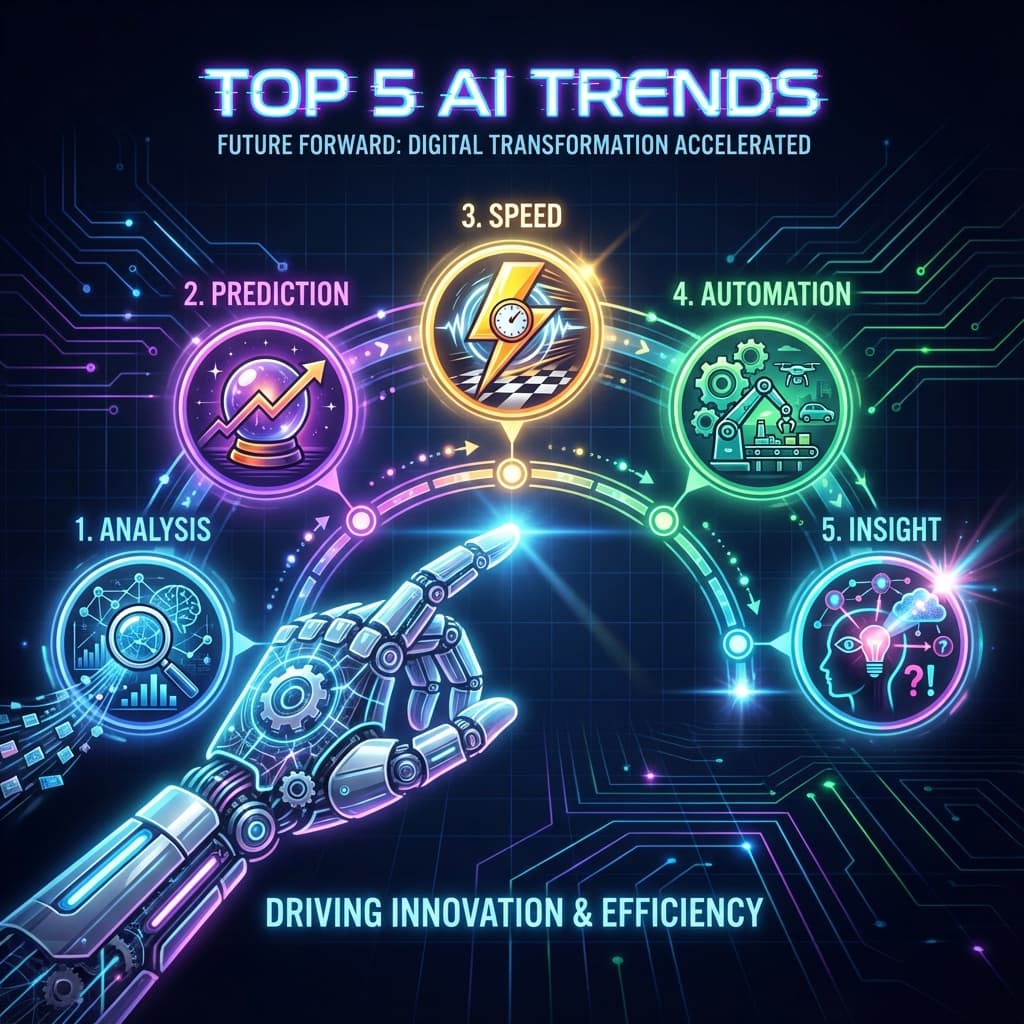
Top 5 AI Trends Reshaping Academic Research in 2025
From automated literature reviews to predictive analytics, explore the top AI trends that are defining the future of academic research this year.
PaperSight Team
PaperSight AI
2025 is shaping up to be a landmark year for Artificial Intelligence in academia. As AI tools become more sophisticated, they are moving from novelty to necessity. Researchers who embrace these technologies are gaining significant advantages in productivity, insight generation, and publication success. Here are the top 5 trends reshaping the landscape of academic research.
1. Automated Literature Reviews
Perhaps no task in research is more time-consuming than the literature review. Traditionally, researchers spend weeks or even months reading through hundreds of papers to understand the current state of their field. AI is changing this dramatically.
How It Works
Modern AI systems can now scan thousands of papers in minutes, identifying key themes, methodologies, and findings. These tools use advanced natural language processing to understand not just keywords, but the actual meaning and context of research.
Industry Statistics
A 2024 survey found that researchers using AI-assisted literature review tools completed their reviews 60% faster than those using traditional methods.
Key Capabilities
- Gap identification - AI can identify underexplored areas in the literature
- Trend analysis - Track how research focus has shifted over time
- Citation network mapping - Visualize the relationships between papers
- Contradiction detection - Find conflicting findings across studies
The PaperSight Advantage
Tools like PaperSight AI allow researchers to upload their collection of papers and ask questions across the entire corpus. Instead of manually reading each paper, you can ask "What methodologies have been used to study this phenomenon?" and get a comprehensive answer in seconds.
2. Predictive Analytics in Hypothesis Generation
The scientific method traditionally relies on human intuition and experience to generate hypotheses. But what if AI could suggest promising research directions based on patterns invisible to human researchers?
Machine Learning for Discovery
AI systems are now being trained on vast databases of scientific literature to identify:
- Unexplored combinations - Connections between fields that haven't been studied together
- Promising intervention targets - In fields like drug discovery, AI predicts which molecules might be worth investigating
- Experimental outcomes - Predicting the likely results of experiments before they're conducted
Real-World Applications
In 2024, DeepMind's AlphaFold effectively "solved" the protein folding problem, a challenge that had stumped researchers for 50 years. This breakthrough is accelerating research in biology, medicine, and pharmaceuticals.
Emerging Trend
Universities are beginning to hire "AI research strategists" who specialize in using machine learning to identify high-impact research opportunities.
Implications for Researchers
This doesn't mean AI is replacing human researchers. Instead, AI is becoming a powerful collaborator that helps humans focus their efforts on the most promising directions. The creative interpretation and validation of results still requires human expertise.
3. Enhanced Peer Review Processes
The peer review system is under unprecedented strain. With more papers being submitted than ever before, reviewers are overworked, turnaround times are extending, and errors are slipping through. AI is stepping in to help.
AI-Assisted Quality Control
AI tools are now assisting editors and reviewers by:
- Statistical verification - Automatically checking whether reported statistics are internally consistent
- Plagiarism detection - More sophisticated detection that goes beyond simple text matching
- Image forensics - Identifying potentially manipulated figures and images
- Reference checking - Verifying that citations support the claims being made
- Formatting compliance - Ensuring submissions meet journal requirements
Reducing Bias
One of the most promising applications is using AI to help reduce bias in peer review. By analyzing patterns in review decisions, AI can flag potential bias and help editors make more equitable decisions.
Important Consideration
AI should augment, not replace, human judgment in peer review. The evaluation of scientific novelty and significance still requires human expertise.
Early Adopters
Journals like Nature and Science are already experimenting with AI-assisted screening. While full AI review is not on the horizon, hybrid approaches are becoming standard.
4. Semantic Search and Knowledge Graphs
Traditional search relies on keyword matching, but this approach fails when different fields use different terminology for the same concepts, or when you're searching for ideas rather than specific terms.
Beyond Keywords
Semantic search understands the meaning behind queries, not just the words. This means:
- Searching for "climate impacts on crop production" finds papers about "agricultural effects of global warming"
- Asking for "studies using qualitative interviews" retrieves relevant papers even if they use different methodological labels
- Finding related concepts automatically surfaces relevant research you didn't know to search for
Knowledge Graphs in Academia
Knowledge graphs represent information as networks of connected concepts. In academic research, this enables:
- Concept mapping - Visualizing how ideas in a field relate to each other
- Expert identification - Finding researchers working on specific problems
- Collaboration discovery - Identifying potential research partners
- Citation prediction - Suggesting relevant papers to cite
Tools Leading the Way
Platforms like Semantic Scholar, Connected Papers, and PaperSight AI are leading this transformation, making it easier than ever to navigate the vast landscape of academic literature.
5. Interactive Document Assistants
The way we consume research papers is fundamentally changing. Static PDFs are giving way to interactive documents that respond to reader questions and adapt to different levels of expertise.
The Rise of Document Chat
Tools like PaperSight AI are pioneering a new paradigm: conversational document interaction. Instead of passively reading, researchers can:
- Ask questions about specific sections
- Request explanations at different levels of complexity
- Compare findings across multiple papers
- Generate summaries tailored to their needs
- Extract data and findings into structured formats
User Insight
"The ability to ask a paper 'what are the main limitations of this study' and get an instant, accurate answer has transformed my review process." — Dr. Michael Torres, University of Michigan
Multi-Modal Understanding
The next generation of document assistants will understand not just text, but:
- Tables and figures - Answering questions about data presented visually
- Mathematical equations - Explaining complex formulas in plain language
- Supplementary materials - Connecting appendices to main text discussions
- Code repositories - Understanding and explaining associated code
Impact on Learning
For students and early-career researchers, these tools democratize access to complex literature. A first-year graduate student can now engage with advanced papers that would previously have been inaccessible without years of domain expertise.
Preparing for the AI-Powered Future
These five trends are not independent—they're interconnected parts of a broader transformation in how research is conducted, communicated, and consumed.
Skills for the Future
Researchers who want to stay competitive should:
- Develop AI literacy - Understand what these tools can and cannot do
- Embrace hybrid workflows - Learn to integrate AI tools into existing processes
- Focus on uniquely human skills - Critical thinking, creativity, and interpretation become more valuable
- Stay ethical - Understand the implications of AI use and maintain scientific integrity
Institutional Changes
Universities and research institutions are adapting:
- New courses on AI tools for research
- Updated guidelines on acceptable AI use in research
- Investments in AI infrastructure and expertise
- Collaboration between computer scientists and domain researchers
Getting Started
Start small: pick one AI tool relevant to your work and integrate it into a single aspect of your workflow. As you gain comfort and understand its capabilities, expand your use.
Conclusion
2025 marks a turning point in academic research. AI is no longer a futuristic concept—it's a practical reality that's reshaping every stage of the research process. From finding and reviewing literature to generating hypotheses and disseminating findings, AI tools are augmenting human capabilities in unprecedented ways.
The researchers and institutions that embrace these changes thoughtfully will be best positioned for success in the coming decades. The key is to view AI not as a replacement for human insight, but as a powerful tool that amplifies our ability to generate knowledge and solve the world's most pressing problems.
The future of research is here. Are you ready?
Written by
PaperSight Team