
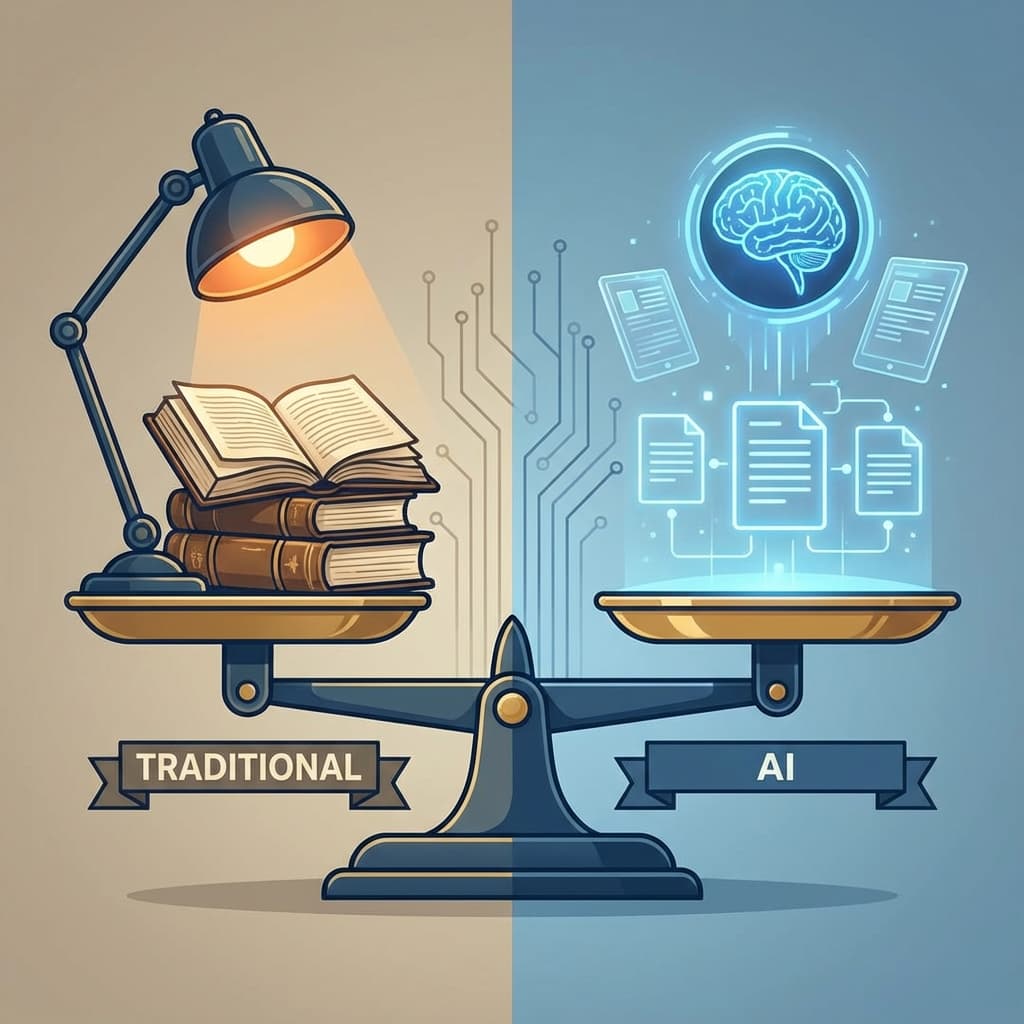
Traditional Reading vs. AI-Assisted Analysis: A Comparative Look
We compare the pros and cons of traditional manual reading versus the new wave of AI-assisted document analysis tools.
PaperSight Team
PaperSight AI
The way we consume scholarly information is undergoing a fundamental shift. For centuries, the process of reading research papers has remained essentially unchanged: you read from start to finish, take notes, and synthesize information in your mind. Now, AI-powered tools promise to transform this process entirely. But is this change for the better?
In this comprehensive analysis, we compare traditional reading methods with AI-assisted approaches, examining the strengths, limitations, and optimal use cases for each.
The Traditional Reading Approach
Let's begin by examining the time-tested method of reading that has served scholars for generations.
How Traditional Reading Works
Traditional reading is fundamentally linear and immersive. The reader starts at the beginning of a document and works through to the end, processing information sequentially in the order the author intended.
The process typically involves:
- Initial scan - Reviewing abstract, introduction, and conclusion
- First read - Reading through the entire document
- Second read - Deeper engagement with key sections
- Note-taking - Highlighting, annotating, or writing separate notes
- Reflection - Mental processing and integration with existing knowledge
Strengths of Traditional Reading
Deep, Contextual Understanding
When you read traditionally, you follow the author's narrative arc. You understand not just what the conclusions are, but how the author arrived at them. This builds a richer mental model of the content.
Research Finding
Studies in cognitive psychology show that sequential reading promotes better understanding of causal relationships and narrative structure compared to fragmented reading.
Serendipitous Discovery
Some of the most valuable insights come from unexpected places. When reading traditionally, you might notice an interesting aside in a methods section, a surprising citation, or an unexpected data point that sparks new ideas.
"I've had some of my best research ideas from tangential observations in papers I was reading for different purposes." — Dr. Robert Williams, MIT
Full Control Over Interpretation
You, the reader, decide what's important. There's no algorithm imposing its understanding of relevance. Your expertise guides what you pay attention to and how you interpret findings.
No Technology Dependencies
A printed paper requires no internet connection, no subscription, no software updates. There's something to be said for the simplicity and reliability of traditional reading.
Deeper Engagement
The effort required for traditional reading—the struggle to understand, the time invested—leads to better retention. This is the concept of "desirable difficulty" in learning science.
Limitations of Traditional Reading
Time Intensive
The average research paper takes 30-60 minutes to read thoroughly. With thousands of papers published daily in most fields, keeping up is mathematically impossible.
Cognitive Load
Working memory is limited. When reading complex documents, mental fatigue accumulates, leading to decreased comprehension in later sections.
Inconsistent Focus
Even the most disciplined readers experience attention drift. Studies show that mind-wandering during reading is common and negatively impacts comprehension.
Difficult Retrieval
A month after reading a paper, can you remember where it discussed a specific point? Finding specific information in documents you've already read is often frustratingly difficult.
Scaling Challenges
Traditional reading doesn't scale. The process that works for reading 5 papers fails when you need to process 500.
The AI-Assisted Approach
Now let's examine the emerging paradigm of AI-assisted document analysis.
How AI-Assisted Reading Works
AI-assisted reading introduces a conversational, query-driven interaction model. Instead of reading linearly, you engage in dialogue with an AI system that has processed the document.
The process typically involves:
- Document upload - The AI processes and indexes the content
- Automatic summarization - AI provides an initial overview
- Query-based exploration - You ask specific questions
- Iterative refinement - Follow-up questions deepen understanding
- Targeted deep reading - Human reading of most relevant sections
Strengths of AI-Assisted Reading
Dramatically Faster
What takes an hour to read traditionally can be surveyed in minutes with AI assistance. This speed advantage compounds when processing multiple documents.
User Data
PaperSight AI users report processing 3-5x more papers per week compared to their pre-AI workflows.
Immediate Answers to Specific Questions
Instead of hunting through a document for specific information, you simply ask. "What sample size was used?" "What were the control conditions?" Instant answers, no scanning required.
Accessibility for Non-Experts
AI can explain technical jargon, simplify complex concepts, and bridge knowledge gaps. This democratizes access to specialized literature.
Superior Information Synthesis
AI excels at identifying connections across different sections of a document or across multiple documents. It can compare methodologies, aggregate findings, and identify patterns that human readers might miss.
Consistent Attention
Unlike human readers, AI doesn't get tired or distracted. It processes the entire document with uniform attention, potentially catching details a fatigued human reader would miss.
Perfect Recall
Once a document is processed, every detail is instantly accessible. Need to find where something was mentioned? The AI can locate it immediately.
Limitations of AI-Assisted Reading
Potential for Hallucination
AI systems can occasionally generate responses that aren't supported by the source document. While this is increasingly rare with modern systems, verification remains important.
Missing Nuance
The subtleties of argumentation, the weight of evidence, the author's hedging language—these can be lost in AI summarization. You might get the facts right but miss the nuance.
Important Consideration
AI summaries should be treated as starting points for understanding, not definitive representations of complex arguments.
Over-Reliance Risk
If you only ever interact with documents through AI, you may lose the deep reading skills that enable genuine expertise. The muscle atrophies if not exercised.
Reduced Serendipity
Query-driven reading tends to find what you're looking for. But what about the valuable insights you didn't know to look for? AI can reduce exposure to unexpected discoveries.
Abstraction from Source
There's a meta-cognitive difference between reading an author's words and reading what an AI says the author said. The latter is inherently one step removed from the source.
Head-to-Head Comparison
Let's directly compare the two approaches across key dimensions:
| Dimension | Traditional Reading | AI-Assisted | |-----------|-------------------|-------------| | Speed | Slow (30-60 min/paper) | Fast (5-10 min/paper) | | Depth | Deep understanding | Variable, depends on queries | | Scalability | Poor | Excellent | | Comprehension | High for focused readers | High for specific questions | | Retention | Generally higher | May be lower | | Serendipity | High | Lower | | Accessibility | Requires domain expertise | More accessible to novices | | Verification | Self-evident | Requires checking | | Mental Effort | High | Lower | | Synthesis | Manual, error-prone | Automated, scalable |
The Hybrid Approach: Best of Both Worlds
In practice, the most effective researchers don't choose one approach exclusively—they combine both strategically.
A Modern Research Workflow
Stage 1: Screening (AI-Assisted)
- Upload candidate papers
- Get AI summaries
- Quickly determine relevance
- Filter to papers worth deeper reading
Stage 2: Targeted Extraction (AI-Assisted)
- Use Q&A to find specific information
- Extract methodology details
- Compare findings across papers
- Build initial understanding
Stage 3: Deep Reading (Traditional)
- Select highest-priority papers
- Read fully with traditional methods
- Engage in critical analysis
- Form your own interpretations
Stage 4: Synthesis (Hybrid)
- Use AI to identify connections across papers
- Manually verify and interpret
- Write synthesis in your own words
- Develop original insights
The 80/20 Split
A practical ratio: Use AI-assisted methods for 80% of your papers (screening and targeted extraction), and traditional deep reading for the 20% that matter most.
When to Use Which Approach
Use Traditional Reading When:
- The paper is central to your research (will cite heavily)
- You need to understand not just what but how and why
- The topic is new to you and you need grounding
- You're developing your own methodology based on the paper
- Critical evaluation of the argument structure is needed
Use AI-Assisted Reading When:
- Screening large numbers of papers for relevance
- Extracting specific factual information
- Getting up to speed on an unfamiliar topic
- Comparing findings across multiple papers
- Time is severely constrained
The Future: Convergence and Enhancement
The dichotomy between traditional and AI-assisted reading is temporary. The future points toward tools that enhance rather than replace human reading.
Emerging Capabilities
Active Reading Companions
Imagine reading a paper while an AI sidebar offers real-time explanations, highlights potentially controversial claims, and shows related work—enhancing rather than replacing your reading.
Personalized Summarization
AI that knows your background and can tailor explanations accordingly. A summary for an expert would differ from one for a novice.
Reading Analytics
Tools that track your reading patterns, identify knowledge gaps, and recommend what to read next based on your evolving understanding.
Collaborative Reading
AI-facilitated reading groups where multiple readers' questions and insights are aggregated, creating collective understanding greater than any individual could achieve.
Practical Recommendations
Based on our analysis, here are actionable recommendations for researchers navigating this landscape:
For Newcomers to AI Tools
- Start by using AI for papers you've already read manually
- Compare AI summaries with your own understanding
- Develop a sense for where AI excels and where it falls short
- Gradually increase reliance as you calibrate trust
For Experienced AI Users
- Ensure you maintain traditional deep reading skills
- Regularly verify AI outputs against source documents
- Use AI for breadth, traditional reading for depth
- Don't let AI determine what's important—bring your own questions
For Research Teams
- Develop shared protocols for AI-assisted literature review
- Clarify what level of verification is required for different use cases
- Train team members in both traditional and AI-assisted methods
- Document when and how AI was used in research processes
Conclusion
Traditional reading and AI-assisted analysis are not competitors—they are complementary tools for different tasks. The question is not which is better, but when to use each.
Traditional reading remains essential for deep engagement with important texts, critical evaluation, and the development of genuine expertise. AI-assisted reading is transformative for managing information overload, quick information retrieval, and synthesis across large bodies of literature.
The most effective researchers will be those who master both approaches and deploy them strategically. They will use AI to extend their reach and traditional reading to deepen their understanding. The future belongs not to those who abandon the old ways for the new, but to those who thoughtfully integrate the best of both.
PaperSight AI is designed to support this hybrid workflow—not to replace your reading, but to multiply its impact. The choice of how to use it remains, as it should, entirely yours.
Written by
PaperSight Team